HOME-09 · Connected Home
Low-Power Temperature and Humidity Sensor PCBA
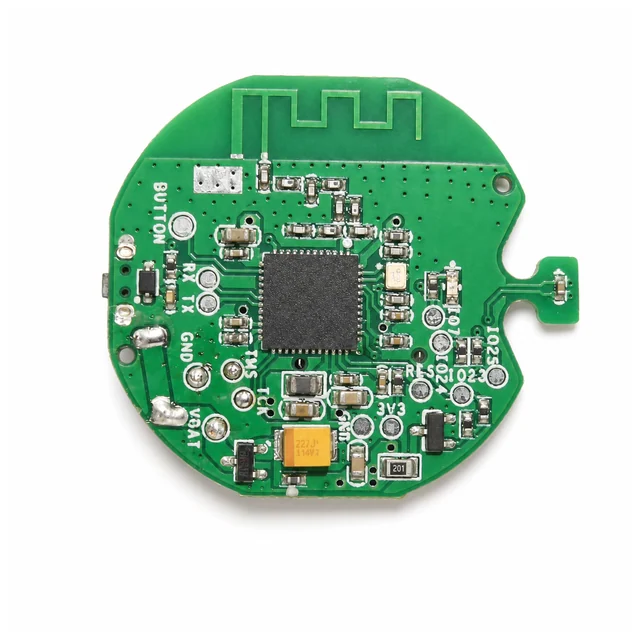
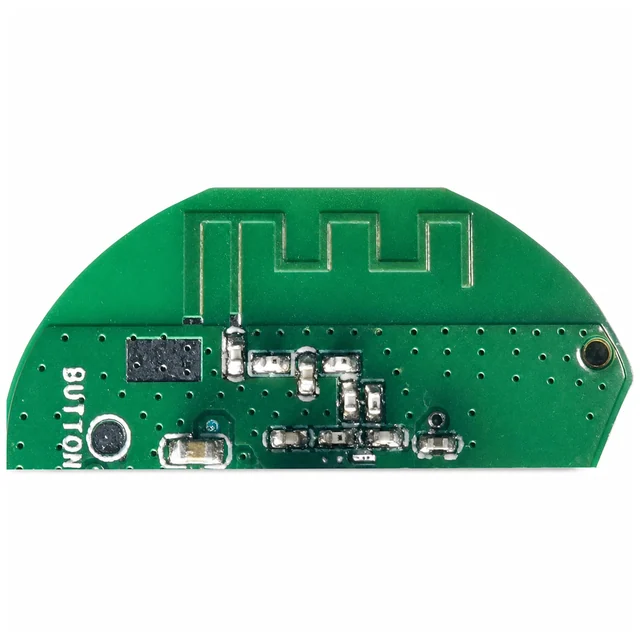
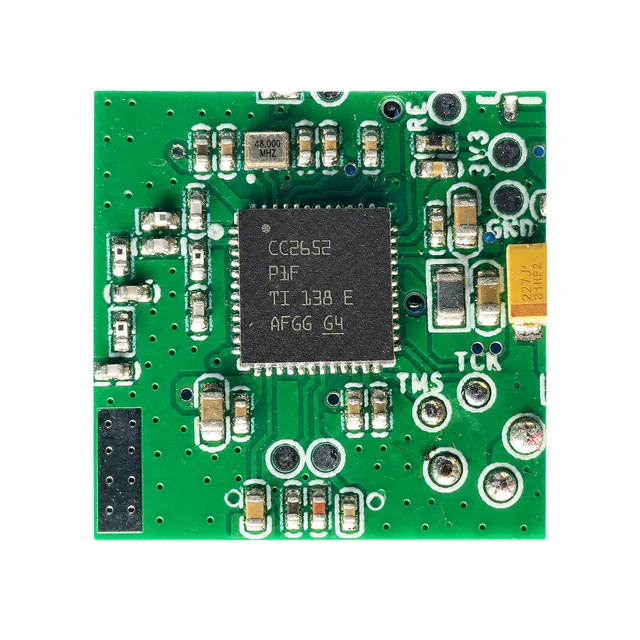
An FCC-photo reference showing a compact sensor node with a TI CC2652-marked wireless device, 48 MHz crystal, programming pads, a board-edge key, RF matching, and a printed antenna.
Project context
How this product is typically engineered
An FCC-photo reference showing a compact sensor node with a TI CC2652-marked wireless device, 48 MHz crystal, programming pads, a board-edge key, RF matching, and a printed antenna.
System architecture
Typical architecture
A representative coin-cell node periodically wakes a low-power 2.4 GHz MCU, samples an environmental sensor and battery voltage, applies calibration and change thresholds, transmits briefly to a gateway, and returns to deep sleep.
Engineering risks to resolve
Decisions to close before release
- Minimize sleep leakage and retry energy while preserving responsive sensing and rejoin behavior.
- Limit measurement error from MCU, battery, crystal, enclosure, and user self-heating.
- Maintain antenna tuning near the battery, wall, hand, and final enclosure without blocking the sensing vent.
Validation plan
Checks to define before production
- Run multi-point temperature and humidity calibration, hysteresis, response-time, condensation-recovery, and drift tests.
- Profile sleep current, wake and transmit peaks, low-voltage behavior, weak-network retries, and projected battery life.
- Verify final-enclosure antenna efficiency, sensitivity, key ESD, drop, vibration, and production RF packet testing.
What to put in the RFQ
Files and records to agree before quoting
Use this list to agree the build inputs and release records for a similar product. The final set depends on the project.
Design baseline
Released schematic or block diagram, interface table, power states, critical constraints, and revision owner.
Manufacturing release
Gerber or ODB++, stack-up, centroid data, assembly drawings, approved DFM dispositions, and panel assumptions.
Material control
Released BOM revision, manufacturer part numbers, AVL or alternate rules, no-substitute lines, MSL handling, and exception approvals.
Validation record
Test method, acceptance criteria, sample or serial identity, measured result fields, and disposition. Example scope: Run multi-point temperature and humidity calibration, hysteresis, response-time, condensation-recovery, and drift tests.
Production release
First-article status plus the agreed SPI, AOI, X-ray, ICT, FCT, programming, rework, OQA, labeling, and packing records.
During RFQ review, we confirm the required fields, sampling, limits, approvals, and record-retention period. Confidential project information stays within the agreed access rules.
Development and production controls
Typical manufacturing scope
- Ultra-low-power environmental sensing.
- 2.4 GHz board-antenna integration.
- Calibration and threshold reporting.
Technical image review
Board-level evidence
White-background views are published to make component placement, interfaces and assembly boundaries easier to inspect.