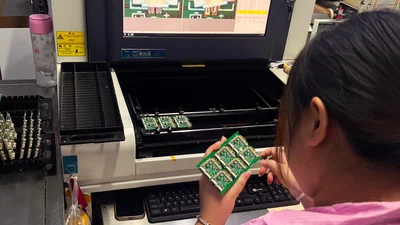
BGA solder joints sit beneath the package, so an external visual check cannot show their condition. X-ray can help assess hidden joints, but equipment alone does not establish process control. Buyers should define how risk is reviewed, what inspection covers, which records are kept and how defects are dispositioned.
The right controls depend on the board, package, product risk and customer requirements. Use the RFQ to agree the scope before tooling or production starts; confirm any supplier-specific capability for the actual build.
Start with product risk
Risk can increase with fine pitch, large packages, dense routing, uneven copper, double-sided reflow, moisture sensitivity or limited test access. Tell the supplier the product use, failure consequences, build quantity and customer standards. Use those inputs to agree inspection depth and records; do not assume one generic level fits every BGA.
Review the design before stencil release
Review pad design, solder-mask definition, via-in-pad fill and cap, escape routing, package clearance, board thickness, copper balance, panelization and fiducials. Check whether thin or asymmetric boards need support during reflow. Record open design questions before stencil release. See the scope for SMT assembly and BGA placement when preparing the RFQ.
Control paste printing with agreed SPI criteria
Paste type and storage, stencil foil and apertures, print settings, cleaning and board support all affect deposited volume. Ask whether SPI covers the BGA population and which measurements are retained. Set the measurement method, limits and reaction plan from the package, board, paste and validated process; there is no universal SPI window or stencil thickness for every design.
| RFQ item | Agree before the build |
|---|---|
| Population | Which BGA pads are evaluated separately |
| Measurement | Volume, height or another defined metric |
| Limits | Project-specific window and who approves it |
| Record | Values or images retained, review owner and reaction |
Profile reflow for the assembly
Build the profile around board thickness, copper, thermal mass, paste specification and component limits. For a new or higher-risk build, agree where profile evidence is needed and how the thermocouple locations represent the assembly. Confirm how profile deviations are reviewed before release.
Define what X-ray must report
Agree which packages are inspected, whether coverage is 100% or sampled, what image views are needed and how results are recorded. Define the criteria for opens, bridges, alignment, collapse indicators and voids, including who reviews borderline results. Voids should be assessed in context: package, electrical or thermal role, measurement method and customer requirement can change the decision.
When a customer invokes an IPC document, name its revision and the applicable class or product-specific exception in the purchase requirements. IPC-A-610 and IPC-7095 provide reference context; they do not replace an agreed inspection method and acceptance rule for the order. Review the IPC release note on the J revisions to IPC-A-610 and J-STD-001; check the current revision with IPC before naming it in your order.
| RFQ item | Define for this product |
|---|---|
| Coverage | Packages, 100% or sample, image retention |
| Method | View, measurement basis and reporting format |
| Acceptance | Customer or product-specific criteria and revision |
| Disposition | Review owner, hold point and rework approval |
Connect hidden-joint inspection with the agreed incoming, in-process, functional and final checks. The quality process page describes the review topics; confirm which checks and records apply to the order.
Manage moisture-sensitive devices
For moisture-sensitive devices, agree how floor life, dry storage, opened reels, humidity indicators, baking and material returns are handled. For customer-supplied kits, provide labels and known exposure history; if history is missing, stop and agree disposition before assembly. Use the MSL material handoff guide to list the information to exchange.
Agree BGA rework and disposition rules
Set rework permission, attempt limits, required equipment or process evidence, post-rework inspection and any repeat electrical test. Define when customer approval is needed and which serial or lot records identify affected boards. Confirm feasibility for the package and board before production; do not infer it from general SMT capability.
Pair inspection with electrical test
X-ray does not prove circuit function. Select electrical tests from board access, volume and product risk: flying probe, boundary scan, ICT, functional test, programming verification or load checks may be relevant. Agree the test procedure, firmware revision, limits and retained result before release.
What to include in the RFQ
- Gerber or ODB++ data, BOM, placement file and assembly drawing
- BGA package list, pitch, quantity and product-use context
- Stack-up, thickness, copper, surface finish and via-in-pad details
- Requested X-ray packages, coverage, criteria and record format
- MSL handling, material ownership and known exposure history
- Electrical test procedure, firmware and pass/fail limits
- Rework approval, retest and disposition rules
Use the PCBA RFQ service paths to define the build scope and the capability and sourcing review to list project questions. The supplier should confirm the quoted process and evidence for the specific package.
Questions for a supplier
- How will you review pad, via-in-pad, stencil and warpage risks before release?
- Which SPI measurements and records will be used for this BGA population?
- What profile evidence will be produced for this board and component mix?
- Which packages will be X-rayed, and how are results dispositioned?
- How are MSL history and customer-supplied material handled?
- What rework, approval and retest rules apply to this package?
- Can the agreed inspection and test records be linked to the lot or serial?
Practical takeaway
BGA quality depends on agreed design, printing, thermal, inspection, material-handling, rework and test controls. Define the requirements with the actual board and product risk, then confirm process scope, records and approval points in the RFQ. Send the available files and requirements to request a project-specific review.