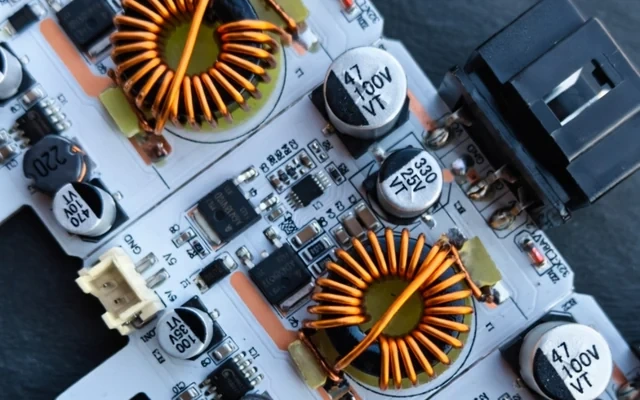
Measurement and connectivity electronics for power and energy data
Energy Monitoring PCBA Development & Manufacturing
We help energy-monitoring teams prepare smart-meter, submeter, power-quality, and equipment-monitoring electronics for controlled pilot and repeat production.
Smart meters and submetersCT and voltage acquisitionMetrology and calibration planningRS-485, Ethernet, and wireless links
Application contextEnergy Monitoring PCBA Development & Manufacturing
Engineering and manufacturing examples; they do not identify a customer or guarantee field performance.
Engineering and manufacturing controls to freeze before pilot release
These controls convert a general assembly request into a reviewable release package for engineering, purchasing, quality, and production.
High-voltage and isolation review
Confirm design assumptions for working voltage, insulation, creepage, clearance, slots, barriers, connectors, coatings, and test method with the buyer.
Metrology component control
Protect shunts, CT interfaces, references, divider networks, precision passives, isolation devices, and approved alternates from uncontrolled substitution.
Calibration and data traceability
Define reference source, load points, power factor or phase conditions, stabilization, firmware, factors, limits, retest, and stored data.
Communications and field behavior
Verify address, protocol, baud rate, network identity, reconnect, timekeeping, data logging, alarms, and relevant I/O.
Certification, regulatory approval, field performance, calibration authority, and final product compliance remain tied to the buyer-approved design, target market, test method, and named responsibility.
Illustrative short case — not a customer claim
A three-channel panel monitor uses external CTs, isolated RS-485, local logging, and a relay output. The first RFQ gives nominal accuracy but not CT variant, burden-network tolerance, calibration load points, Modbus address rules, or per-channel data format. Before the pilot, the team freezes the measurement BOM, records the reference setup and firmware, links calibration factors to serial and channel, and adds communication, relay, restart, and data-retention checks.
Buyer lesson: freeze the product-specific decision inputs and acceptance evidence before the first article; do not rely on a generic “power-on test” or assembly note.
What to include in the RFQ package
Clear files reduce quotation assumptions and make engineering, tooling, programming, inspection, test, and recurring-production costs easier to separate.
Required engineering inputs
Released PCB data, BOM, centroid, assembly drawings, schematics, stack-up, and marked isolation or high-voltage areas
Channel count, sensor or CT type, measurement range, accuracy target, and approved precision components
Working voltage and buyer-defined safety, creepage, clearance, insulation, and dielectric test requirements
Calibration points, reference equipment, fixture, firmware, factors, limits, retest rules, and data format
Communication protocols, addressing, timekeeping, logging, relay or alarm behavior, and product variants
Pilot quantity, forecast, operating environment, enclosure, labels, certification responsibilities, and packaging
Commercial and approval decisions
Separate prototype, NPI, tooling, fixture, programming, test, special process, packaging, and recurring unit costs.
Identify buyer-supplied, consigned, supplier-sourced, and approved-alternate materials.
Name the owner for deviations, substitutions, firmware, labels, test limits, and shipment release.
Energy Monitoring PCBA Development & Manufacturing FAQ
Can you assemble smart-meter and energy-monitoring PCBAs? Yes. Quotations should define the measurement chain, precision components, isolation assumptions, firmware, communication interfaces, calibration or functional test, and target-market responsibilities.
Can calibration factors be recorded by serial number? A traceable record can be planned when the serial format, channel identity, firmware, reference setup, calculation, limits, retest rule, storage format, and owner are defined.
How are high-voltage areas handled during manufacturing review? The released inputs should identify working voltage, isolation boundaries, creepage, clearance, slots, barriers, coatings, connectors, markings, and required inspection or dielectric tests. Final compliance remains tied to the approved design and target requirements.
What should be included for an accurate energy-monitoring RFQ? Include PCB data, BOM, schematics, channel and sensor details, accuracy target, isolation requirements, calibration plan, firmware, protocols, variants, environment, quantities, and certification ownership.
Prepare a decision-ready Energy Monitoring PCBA RFQ
Send the released files, product variants, pilot quantity, forecast, operating environment, open requirements, and acceptance plan. We will identify the information needed for a manufacturing review and quotation.