

Choose a turnkey PCBA supplier by checking whether it can execute your actual build with clear responsibilities and usable records. A machine list, low unit price or polished sample does not answer how your revisions, component risks, inspection decisions and repeat orders will be tracked.
Scorecard version 1.0, reviewed 30 August 2026. Score only records observed; a critical project risk can override the numeric result.

If you are comparing suppliers for turnkey PCB assembly in China, use our SMT setup verification checklist during the factory visit to see how the line is set up and recorded.
1. Give each supplier the same evaluation brief
Send one released or clearly marked preliminary package: fabrication data, BOM, placement file, assembly drawings, quantity breaks, intended use, test requirements and target delivery milestone. Identify which information may change. Ask suppliers to list their assumptions, exclusions, engineering questions and any process they propose to subcontract.
Compare the same work. A quote that includes bare-board fabrication, material sourcing, programming and functional testing cannot be compared directly with assembly-only pricing. The PCBA cost-breakdown guide helps separate recurring charges, one-time setup and excluded work.
2. Replace general questions with records requests
On small screens, scroll the table sideways to compare columns.
| Area | Request | What a useful response explains |
|---|---|---|
| Engineering release | A redacted review record or sample review of your package | Revision links, unresolved questions and approval before production |
| Material sourcing | A shortage and alternate-approval register | Source, dated availability, approval status and who owns substitutions |
| Process control | Relevant setup and first-article records | How the approved program, material and process apply to the inspected unit |
| Inspection and test | A proposed coverage matrix and sample result format | Which faults or functions are checked, stated limits and traceable retests |
| Traceability | A demonstration using one permitted serial or lot identifier | How build configuration, results and release rework or scrap decision can be retrieved |
| Repeat orders | Change, fixture-maintenance and leftover-material procedures | What is rechecked, who approves changes and who owns retained assets |
Redacted records can be sufficient for an initial review; do not request another customer's confidential design files. Check that the example relates to the process, site and complexity you need. A sample record demonstrates a format, while a pilot on your design tests execution against your requirements.
3. Set mandatory gates before applying scores
List requirements whose absence prevents award: for example, an agreed sourcing route for a restricted component, a required customer approval, the ability to perform a specified test, or an acceptable data-handling arrangement. Do not let a high weighted score conceal an unmet mandatory requirement.
Use the existing supplier scorecard to record observed records and follow-up actions. Keep “not yet verified,” “not applicable” and “does not meet the requirement” distinct. Record the date, reviewer and records reference. If a certificate is relevant, check the issuing body, named legal entity, site, scope and validity rather than relying on a logo or an unrelated group certificate.
4. Compare two suppliers without inventing precision
Hypothetical evaluation example: Supplier A submits a lower assembly price but excludes fixture preparation and has not confirmed source traceability for a critical part. Supplier B includes fixture preparation and provides the requested material record format, but its delivery assumption begins only after customer approval.
The next step is to close these scope and records gaps. Request a comparable price from A and a dated approval-to-delivery plan from B. If critical sourcing records are a mandatory gate, A remains on hold regardless of its price score. These are example decision conditions, not statements about real suppliers or measured project results.
5. Use the pilot to test the proposed workflow
- Lock the pilot scope, variants, quantities and build-file revisions.
- Agree the first-article hold point and the person who can release the remaining lot.
- Define the required inspection, programming and functional-test records in advance.
- Track engineering questions and deviations through closure, including approved rework and retest.
- Review the delivered production file set against the original agreement and record unresolved limits before the next order.
A successful prototype does not automatically establish readiness for a larger or recurring order. Review capacity assumptions, sourcing continuity, fixture availability and change control for the intended production pattern. Use the first-article inspection guide to specify the pilot records and the ramp guide to close the next release gate.
6. Resolve commercial responsibilities in writing
Record who owns stencils, fixtures, programs and excess components; storage and retrieval arrangements; approved purchasing authority; change charges; acceptance and rework responsibilities; and the shipment milestone. For subcontracted work, identify the responsible party and the records that comes back into the production file set.
Ask who owns communication, who can approve technical changes and when a blocked decision is escalated. A named contact is helpful, but the project also needs a retrievable decision record. Align these details with the overseas engineering and export handover guide.
7. Verify identity, standards and inspection coverage
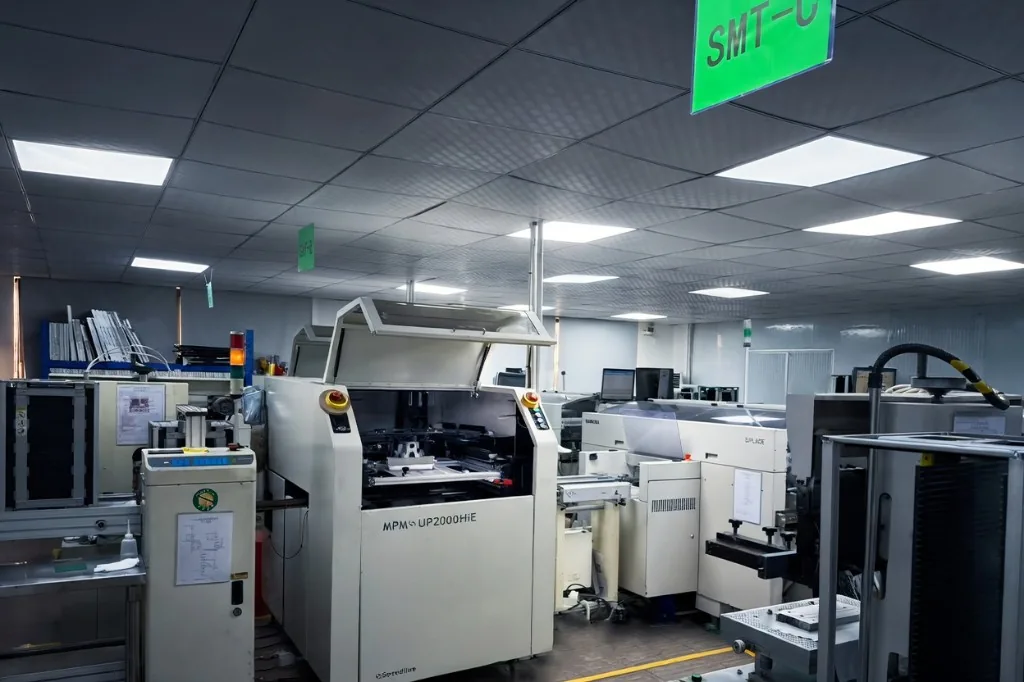
Confirm who will actually build the boards. Some suppliers are trading companies that place the order with another factory. That can work, but it should be stated. Check that the legal company name on the quotation matches its registration and business scope in China's National Enterprise Credit Information Publicity System, and ask for a live video walk-through of the SMT line and incoming inspection rather than edited promotional footage.
Check certificates with the issuing certification body: number, scope and expiry date. ISO 9001 is the baseline; automotive programmes normally call for IATF 16949 and medical devices for ISO 13485. Write the workmanship standard into the quotation or purchase order, usually IPC-A-610 Class 2 or Class 3, so inspection decisions have an agreed reference.
Agree the inspection coverage for each board: solder-paste inspection (SPI) and automated optical inspection (AOI) on the SMT line, and X-ray for BGA, QFN, LGA and other hidden joints, at least on first articles. Ask how moisture-sensitive components are stored, tracked and baked under IPC/JEDEC J-STD-033, and request sample AOI, X-ray and MSL records before the order is awarded.
Red flags before you award the order
- The company name on the quotation, invoice and bank account does not match.
- A firm price arrives within hours on a complex BOM, with no engineering questions.
- "All parts are original" with no description of sourcing channels or substitution approval.
- Certificates that cannot be checked with the issuing body, or have expired.
- No live view of the production floor, only edited promotional video.
- Reluctance to run a pilot build or share first-article results.
None of these proves a supplier is unsuitable, but each one deserves a follow-up question before production money is committed.
Supplier-selection questions
Can the scorecard select a supplier automatically?
No. It structures comparison. Mandatory requirements, records gaps and the product's risks still need a documented decision by the responsible buyer and engineering team.
What if a supplier cannot share customer records?
Request a redacted format, a tracked demonstration or a pilot record for your own project. Protecting customer confidentiality is compatible with demonstrating a process.
What should I send for an initial review?
Send the files you have, identify their release status and describe quantity, testing and delivery needs through the PCBA RFQ form. An incomplete package should produce explicit assumptions and questions before a final commitment.