
No Hardware Team? How Product Brands Work With Us
You can start with only an idea. See what we develop for product brands, what you decide, and who keeps the design files, before you send an inquiry.
Read the guide →Explore components, board layers, circuits, manufacturing, quality and product handovers through six interactive chapters.
Practical manufacturing guides for teams comparing suppliers, quote packages, workmanship expectations, traceability, BOM risk, and prototype-to-production scale-up.
Three short guides: how product brands work with us, what happens after you send files, and which projects we are a good fit for.
You can start with only an idea. See what we develop for product brands, what you decide, and who keeps the design files, before you send an inquiry.
Read the guide →See what our first reply contains, who writes it, and each step from payment to shipped boards, including the points where you sign off.
Read the guide →See which PCB assembly projects we handle well, which ones we do not, and what to send us to get an engineering reply within 1 business day.
Read the guide →October 29, 2026 · Five focused guides on material sources, board finishes, ESD handling, selective soldering and EMS transfers.
Build a component-source records chain from purchasing channel to physical lot, with clear exception holds, quantity reconciliation and material-release responsibility.
Read the guide →Compare ENIG, lead-free HASL and OSP using pad geometry, soldering sequence, storage, contact functions and tracked finish-change records.
Read the guide →Review ESD controls across exposed-board handling, fixtures, queues and repair, using program scope, verification records and a defined interruption response.
Read the guide →Review selective-soldering access envelopes, component and tooling tolerances, thermal constraints and representative joint records before layout release.
Read the guide →Control an EMS production transfer with an asset register, receiving-site process delta, matched verification, inventory reconciliation and explicit cutover gates.
Read the guide →October 23, 2026 · Practical checklists for board bring-up, separation and receiving.
Plan first power-on with unpowered checks, approved supply limits, rail sequencing, stop conditions and traceable production-test handover.
Read the guide →Review panel separation methods, fixture support, component stress risks and validation records before releasing a PCBA depanelization process.
Read the guide →Check shipment identity, condition, test records and serial traceability, then control holds and partial release with an OEM receiving checklist.
Read the guide →Start with a procurement task, then explore the relevant engineering guidance.
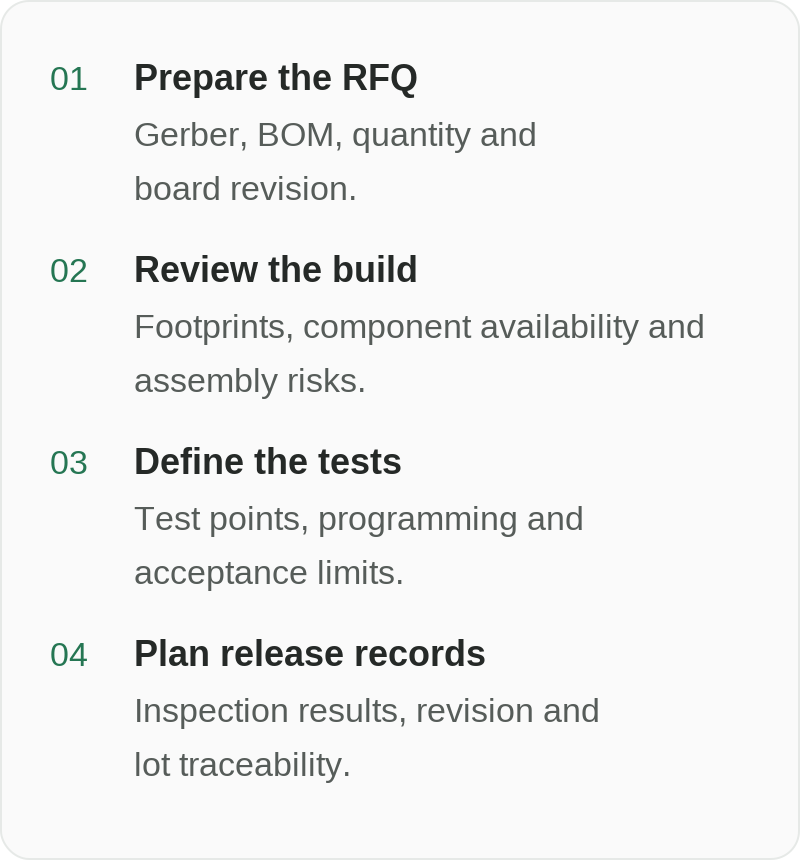
Align files, quantities and the scope suppliers will quote.
RFQ package checklist →Review availability, alternates and material controls.
BOM sourcing guide →Check design and assembly risks before releasing the build.
DFM review guide →Define first-article checks and release records.
First-article guide →Choose coverage and the records required at delivery.
Test strategy guide →Each guide connects technical context to a practical manufacturing decision: what to send, what to verify, what to control, and what to request as records.
Gerber, BOM, placement, drawings, quantity breaks, test scope, and export notes reduce clarification loops.
DFM, panelization, BGA/X-ray, MSL, coating, and fixture topics help teams act before production pressure rises.
Traceability, AOI/SPI, ICT/FCT, OQA, labels, and shipment records turn quality claims into reviewable records.
Supplier selection guides connect price, lead time, sourcing control, communication, and release discipline.
These guides answer the topics already appearing in search: PCBA supplier comparison, PCBA manufacturing for overseas customers, IPC Class 2 vs Class 3, and PCBA traceability records.
Separate released parts, approved alternates, qualification candidates, and lot-specific deviations with records, scope, traceability, and named approval.
Verify the released data package, material identity, setup, workmanship, inspection, programming, test records, deviations, traceability, and approval decision.
Compare turnkey PCBA suppliers with complete BOM, Gerber, centroid, assembly notes, quantity breaks, test scope, and export delivery requirements.
Set workmanship class, inspection depth, void criteria, reflow concerns, and MSL rules before production, especially for hidden-joint devices.
Define component traceability, test logs, label rules, firmware variants, coating, lifecycle support, and change approval paths early.
Use the primary page for the decision, the technical guide for implementation detail, and the case library for comparable architecture, risks, validation planning, and evidence-packet scope.
Align fabrication data, BOM, placement, drawings, quantities, test scope, quality records, packaging, and delivery assumptions before suppliers price different scopes.
Separate approved manufacturer part numbers, AVL rules, no-substitute lines, lifecycle exposure, alternates, customer-supplied items, and exception approval before purchase.
Choose coverage from product risk, test access, design maturity, fault-isolation needs, volume, fixture economics, cycle time, and the release log required for each unit or lot.
Define the chain from BOM and material lots to work order, process programs, firmware, inspection, test, rework, serial identity, packing, shipment, retention, and export format.
Map enclosures, harnesses, firmware, labels, accessories, torque, final test, cosmetic acceptance, packing, serial identity, and shipment release into one owned scope.
Separate material, assembly, inspection and test, one-time engineering or tooling, and delivery costs. Compare the same revision, quantity and acceptance scope, then state exclusions and material commitments. A low unit price is incomplete when required one-time charges or test work sit outside it.
Agree the start event and the finish event. Released manufacturing data, usable material, tooling and test readiness can constrain the build; transit and customer holds may sit outside the quoted interval. Ask for a dated dependency plan before assuming that an order date starts every lead-time clock.
Keep the affected material identified and follow the authorized hold and assessment process. Use the device classification, container history and applicable manufacturer instructions to establish the next action. Resealing a bag does not reconstruct missing exposure history, and one generic baking recipe is not a substitute for that review.
Give both suppliers the same build brief and acceptance requirements. Resolve mandatory capability and records gates before weighting price, schedule or convenience. Ask for records tied to the proposed site, configuration and inspection or test scope; a logo or general capability statement does not establish suitability for the actual order.
Find checklists, worked examples and engineering guides for the decision in front of you. Browse by topic or use the article cards below.
PCBA PARTNER publishes these guides as team-authored engineering resources. A team label describes the accountable function—not an invented individual biography. Named technical reviewers are added only after their identity, role, and approval to be publicly listed have been confirmed.
Share your current files or describe the build. We’ll identify the scope that needs review.
Use the cooperation guide to define the next step, or inspect published customer work.